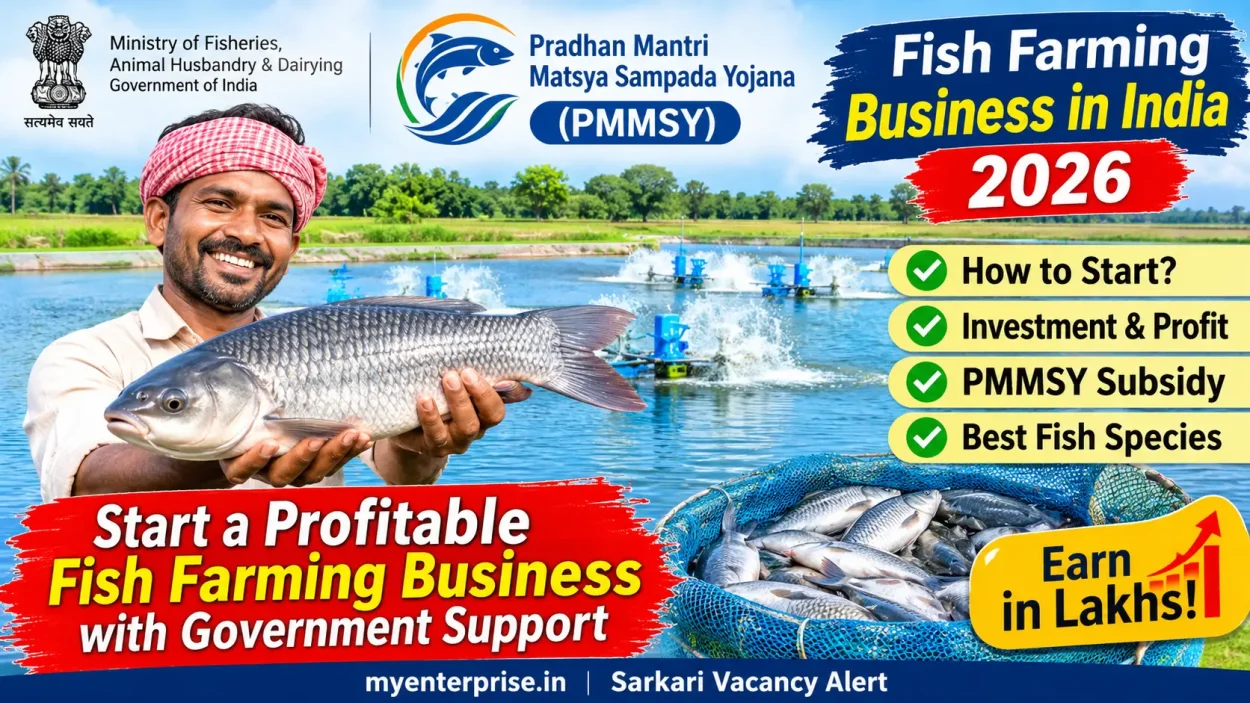
Fish farming is emerging as one of the promising business opportunities in India, particularly for people looking to start a small-scale business in rural and semi-urban areas. With increasing demand for fresh fish, growing awareness about healthy food and support from government fisheries schemes, aquaculture has become an attractive option for farmers, entrepreneurs and individuals looking to generate additional income.
The fisheries sector has witnessed considerable growth in recent years, with government initiatives helping fish farmers adopt modern technology, improve productivity, reduce post-harvest losses and connect with better markets. One of the most important government initiatives in this sector is the Pradhan Mantri Matsya Sampada Yojana (PMMSY).
Launched in September 2020, PMMSY aims to strengthen India’s fisheries sector by improving fish production, promoting sustainable aquaculture, upgrading infrastructure, enhancing fish quality and supporting the livelihoods of fishers and fish farmers.
For people planning to start a fish farming business in 2026, this sector offers opportunities to start on a small scale and gradually expand. With proper planning, suitable fish species, good pond management, quality fish seeds, adequate feeding and access to the market, fish farming can become a sustainable source of income.
In this article, we will explain how to start a fish farming business in India, the investment required, potential profits, popular fish species, marketing opportunities and how government schemes such as PMMSY can help fish farmers.
What Is Fish Farming Business?
Fish farming, also known as aquaculture, is the process of raising fish in a controlled environment for commercial production and sale. Fish are cultivated in ponds, tanks, cages, raceways or other water-based systems where farmers manage feeding, water quality, fish health and growth.
The primary objective of fish farming is to produce healthy fish in a planned manner to meet the demand of consumers, restaurants, hotels, retailers and wholesale markets.
In India, pond-based fish farming remains one of the most accessible methods for small-scale entrepreneurs because it can be started with existing ponds, leased land or newly developed pond infrastructure, depending on the local conditions.
Fish farming may be carried out for different purposes, including:
- Commercial fish production: Raising fish for sale in local and wholesale markets.
- Freshwater aquaculture: Cultivating fish in freshwater ponds, tanks and other suitable water bodies.
- Intensive fish farming: Raising fish at higher stocking densities with greater management, feeding and aeration requirements.
- Integrated fish farming: Combining fish farming with agriculture or other farming activities.
- Fish seed production: Producing fish fry and fingerlings for sale to fish farmers.
Fish farming can be started on a small scale and expanded gradually as the farmer gains experience, develops market connections and improves production capacity.
Why Fish Farming Business Is a Good Opportunity in India in 2026
India has a large consumer market for fish and fisheries products. Fish is consumed across many states and is an important source of protein, making fisheries a significant livelihood and commercial activity.
The fish farming business can be attractive for several reasons.
1. Growing Demand for Fish
Demand for fresh fish, freshwater fish and processed seafood continues to create opportunities for fish farmers, traders and entrepreneurs. Local markets, hotels, restaurants and retail businesses require regular supplies of fish.
2. Opportunity to Start with Moderate Investment
A small fish farming business can potentially be established with a moderate investment, particularly when an entrepreneur already has access to a suitable pond, land or water infrastructure.
3. Government Support for Fisheries
The government provides support to fisheries development through schemes such as the Pradhan Mantri Matsya Sampada Yojana. Eligible beneficiaries may receive assistance for approved fisheries activities, subject to scheme guidelines.
4. Multiple Fish Species to Choose From
Farmers can select fish species according to climate, water availability, local demand, farming experience and available infrastructure.
5. Potential for Additional Income
Fish farming can be operated as a full-time business or alongside agriculture and other rural activities, depending on the scale of production and management requirements.
What Is Pradhan Mantri Matsya Sampada Yojana (PMMSY)?
The Pradhan Mantri Matsya Sampada Yojana (PMMSY) is a flagship government scheme designed to promote the sustainable and responsible development of the fisheries sector in India.
The scheme was launched in September 2020 under the Ministry of Fisheries, Animal Husbandry and Dairying, Government of India.
PMMSY aims to increase fish production and productivity, improve the quality of fisheries infrastructure, promote modern aquaculture technology, reduce post-harvest losses and improve the income and livelihoods of fishers, fish farmers and other fisheries-related stakeholders.
The scheme builds upon the broader Blue Revolution initiatives and seeks to strengthen the fisheries value chain, from fish production to processing, transportation and marketing.
Through different fisheries development activities, PMMSY encourages the adoption of modern farming practices, improved fish seed, better infrastructure and sustainable fisheries management.
Objectives of PMMSY
The major objectives of Pradhan Mantri Matsya Sampada Yojana include:
- Increasing fish production and productivity.
- Promoting sustainable and responsible fish farming.
- Improving fish seed quality and availability.
- Encouraging modern aquaculture technology.
- Reducing post-harvest losses.
- Developing cold-chain facilities and transportation infrastructure.
- Improving fish processing and marketing facilities.
- Promoting fisheries entrepreneurship.
- Improving the income of fish farmers and fishers.
- Creating employment opportunities in the fisheries sector.
How PMMSY Helps Fish Farmers
The scheme is designed to support the fisheries sector at different stages of production and marketing.
| Area | How It Can Help |
|---|---|
| Fish Production | Support for eligible fish farming and production-related activities. |
| Technology | Promotion of modern aquaculture practices. |
| Fish Seed | Improvement of seed production and availability. |
| Infrastructure | Development of approved fisheries infrastructure. |
| Post-Harvest Management | Reduction of losses through better handling and facilities. |
| Cold Chain | Support for eligible storage and transportation facilities. |
| Entrepreneurship | Encouragement of fisheries-based business activities. |
| Marketing | Improvement of market access and fisheries value chains. |
Financial assistance under PMMSY is activity-specific and subject to the applicable guidelines, project approval, beneficiary eligibility, state implementation arrangements and availability of funds. The scheme does not guarantee a subsidy for every fish farming project.
How to Start a Fish Farming Business in India
Starting a fish farming business requires proper planning, selection of the right fish species, preparation of the pond, management of fish feed and water quality, and arrangements for selling the harvested fish.
Here is a step-by-step guide to starting a fish farming business.
Step 1: Select a Suitable Location
The first step is to choose a suitable location for your fish farm. A location with adequate water availability, suitable soil, good drainage and easy access to markets can help make fish farming more manageable.
Before starting the business, consider the following factors:
- Availability of land or an existing pond.
- Reliable water source.
- Soil suitability for pond construction.
- Electricity availability, especially for aeration and pumping.
- Road connectivity for transporting fish.
- Availability of fish seed and feed.
- Nearby fish markets, restaurants and wholesalers.
A fish farm located near a market or transport route may help reduce transportation costs and make it easier to sell fresh fish.
Step 2: Construct or Prepare the Fish Pond
Pond-based fish farming is one of the commonly used methods of aquaculture in India. A properly prepared pond provides an environment in which fish can grow and develop.
If you already have a pond, it may need cleaning, repair, water management and preparation before stocking fish.
Pond preparation may involve:
- Removing excessive weeds and unwanted aquatic vegetation.
- Repairing pond embankments.
- Ensuring proper water inlet and outlet arrangements.
- Checking water depth and drainage.
- Managing water quality.
- Removing unwanted predatory fish where appropriate.
- Preparing the pond according to the selected fish species.
The pond should be prepared according to technical recommendations from fisheries experts rather than relying on a fixed size or depth for every fish species.
Step 3: Select the Best Fish Species
Choosing the right fish species is one of the most important decisions in a fish farming business. The species should be selected according to local climate, water conditions, availability of quality fingerlings, farming methods and market demand.
Some popular fish species for aquaculture in India include:
| Fish Species | Characteristics |
|---|---|
| Rohu | Popular freshwater fish with strong demand in many Indian markets. |
| Catla | Commonly cultivated Indian major carp. |
| Mrigal | Frequently used in freshwater pond farming. |
| Tilapia | Suitable for certain aquaculture systems with proper management and regulatory compliance. |
| Catfish | Different varieties are commercially cultivated in suitable environments. |
| Pangasius | Commercially cultivated in suitable farming systems. |
| Trout | Requires suitable cold-water conditions and specialized management. |
Rohu and Catla
These are among the commonly cultivated Indian major carp species. They are suitable for many freshwater aquaculture operations and are often cultivated in composite fish farming systems.
Tilapia
Tilapia can grow well in suitable environments and is cultivated in different aquaculture systems. Farmers should follow applicable local regulations and approved farming practices when selecting tilapia.
Catfish
Some catfish species are commercially farmed because of their adaptability to certain production systems. Species selection, stocking and management should be based on expert guidance.
Trout
Trout farming can be profitable in suitable cold-water regions, but it requires specialized infrastructure, suitable water temperatures and greater technical knowledge.
Step 4: Purchase Quality Fish Seeds or Fingerlings
Fish seed quality plays a major role in determining the success of a fish farming business.
Farmers should purchase fish fingerlings from reliable hatcheries, authorized suppliers or fisheries departments wherever possible.
While purchasing fingerlings, consider:
- Fish species and variety.
- Size and health of fingerlings.
- Supplier reputation.
- Transportation and handling conditions.
- Compatibility with the pond and water conditions.
- Recommended stocking density.
Healthy fish seed can help reduce mortality and improve the chances of achieving a successful harvest.
Step 5: Manage Fish Feed Properly
Fish feed is one of the major operating expenses in commercial fish farming.
The nutritional requirements of fish change as they grow. Farmers should use suitable feed according to fish species, size and growth stage.
Important feed management practices include:
- Use quality fish feed.
- Follow feeding recommendations for the selected species.
- Avoid excessive feeding.
- Monitor fish growth regularly.
- Adjust feed according to fish size and pond conditions.
- Avoid feed wastage.
- Maintain records of feed consumption.
Excessive feeding can increase costs and negatively affect water quality. Proper feeding management can help improve growth and reduce unnecessary expenses.
Step 6: Maintain Water Quality and Fish Health
Good water quality is essential for fish growth and survival.
Fish farmers should regularly monitor water quality and ensure that their ponds have suitable conditions for the selected fish species.
Important water quality parameters include:
- Dissolved oxygen.
- Water temperature.
- pH.
- Ammonia levels.
- Water transparency.
- Overall pond condition.
Aeration may be necessary depending on stocking density, pond conditions and farming methods.
Farmers should also watch for unusual fish behaviour, reduced feeding, fish floating near the water surface or other signs of illness.
Early intervention and expert advice can help prevent serious fish health problems.
Step 7: Harvest the Fish at the Right Time
Fish harvesting should be planned according to fish growth, market demand, production conditions and the expected selling price.
Before harvesting, farmers should identify potential buyers and arrange transportation to avoid unnecessary delays.
Harvesting may be carried out in stages or as a complete harvest, depending on the farming system.
Proper harvesting, handling and transportation can help maintain fish quality and reduce losses.
How Much Investment Is Required to Start Fish Farming Business?
The investment required to start a fish farming business depends on whether you already have a pond, the size of the farm, the fish species, equipment requirements, stocking density and production system.
A small-scale fish farming business may potentially be started with an investment of approximately ₹1 lakh to ₹2 lakh if suitable infrastructure is already available or the project is relatively small.
The ₹1–2 lakh figure is an indicative starting estimate, not a universal project cost. A new pond construction project, intensive aquaculture setup or larger commercial operation may require substantially higher investment.
Estimated Initial Investment for Small-Scale Fish Farming
The following is an illustrative budget for a small-scale fish farming project.
| Expense | Estimated Cost |
|---|---|
| Pond preparation and minor repairs | ₹20,000–₹40,000 |
| Fish seeds or fingerlings | ₹10,000–₹20,000 |
| Fish feed | ₹30,000–₹50,000 |
| Equipment and aeration | ₹15,000–₹30,000 |
| Water management and other supplies | ₹5,000–₹10,000 |
| Labour and miscellaneous expenses | ₹10,000–₹20,000 |
| Estimated Total | ₹90,000–₹1,70,000 |
These figures are illustrative only. They do not represent official project cost norms or guaranteed business expenses. Actual investment will depend on local rates, pond availability, farm size and production requirements.
If you have your own pond and basic infrastructure, your initial investment may be lower. However, if you need to purchase land, construct a pond, install a water supply system, buy machinery or develop intensive fish farming infrastructure, the investment can be significantly higher.
Can You Get a Government Subsidy for Fish Farming?
Yes, eligible fisheries-related projects may receive government financial assistance under fisheries development schemes, including the Pradhan Mantri Matsya Sampada Yojana, subject to the applicable guidelines.
PMMSY supports various fisheries-related activities and eligible project components. Assistance may be available for approved infrastructure, aquaculture development, fish production, processing, transportation, marketing and other activities depending on the scheme provisions.
PMMSY Subsidy Structure
Under commonly applicable PMMSY beneficiary-oriented provisions, the indicative assistance pattern for eligible activities has generally been:
| Beneficiary Category | Indicative Government Assistance |
|---|---|
| General category beneficiaries | 40% of eligible project cost |
| SC/ST and women beneficiaries | 60% of eligible project cost |
These percentages are not applicable automatically to every fisheries activity or project. The actual subsidy amount, eligible components, cost ceilings, project conditions, funding availability and approval process must be confirmed from the latest official guidelines and the concerned fisheries department.
Example of Subsidy Calculation
Suppose an eligible fish farming project has an approved project cost of ₹2,00,000.
| Category | Illustrative Assistance | Beneficiary Contribution |
|---|---|---|
| General category (40%) | ₹80,000 | ₹1,20,000 |
| SC/ST or women category (60%) | ₹1,20,000 | ₹80,000 |
This is a mathematical illustration based on the indicative percentage pattern, not confirmation that a ₹2 lakh project qualifies for this subsidy. Eligibility and approved costs depend on the activity-specific scheme guidelines.
How to Apply for PMMSY Assistance
Individuals interested in starting a fish farming business and seeking government assistance should generally follow these steps:
- Prepare a fish farming project proposal.
- Identify the eligible fisheries activity.
- Contact the District Fisheries Office or relevant state fisheries department.
- Check the latest PMMSY guidelines and application requirements.
- Submit the required documents and application.
- Obtain approval as required before starting the subsidized activity.
- Follow the department’s instructions regarding implementation, inspection and financial assistance.
Applicants should confirm the current application window and whether their proposed activity is being accepted under the relevant state or district implementation programme.
Where to Sell Fish for Higher Profits?
Marketing is an important part of a successful fish farming business. Producing fish is only one part of the business; finding reliable buyers and selling the harvested fish at competitive prices is equally important.
Fish farmers can sell their produce through several channels.
1. Local Fish Markets
Local fish markets are one of the most accessible places to sell fresh fish. Farmers can supply fish directly to traders, retailers and individual consumers.
Direct selling may help farmers reduce dependence on intermediaries.
2. Hotels and Restaurants
Hotels, restaurants, dhabas and catering businesses often require regular supplies of fresh fish.
Fish farmers can approach local businesses and negotiate regular supply arrangements based on quantity, quality and price.
3. Wholesale Fish Buyers
Wholesale buyers may purchase fish in larger quantities, making them suitable for farmers who produce fish on a commercial scale.
Developing relationships with wholesalers can help farmers sell larger quantities and manage harvests more efficiently.
4. Retail Shops
Fish farmers can supply fresh fish to local grocery stores, fish shops and seafood retailers.
Regular supply arrangements can help farmers develop long-term business relationships.
5. Online Marketing and Social Media
Social media platforms such as WhatsApp, Facebook and Instagram can help fish farmers promote their products to nearby customers.
Farmers can use digital platforms to:
- Share fish availability and harvest updates.
- Take orders from local customers.
- Promote home delivery.
- Build a regular customer base.
- Advertise fresh fish products.
6. Selling Processed Fish Products
Depending on the available infrastructure, market demand and applicable food safety requirements, fish farmers may explore value-added products such as cleaned fish, fillets, frozen fish and other processed products.
Processing and packaging may require additional investment, licensing and suitable facilities, but they can provide opportunities to diversify the business.
How Much Can You Earn from Fish Farming Business?
The income from fish farming depends on several factors, including fish species, pond size, stocking density, feed costs, mortality rates, water quality, production cycle, market prices and the farmer’s ability to sell the produce.
A small fish farming business may generate an annual profit of approximately ₹2 lakh to ₹3 lakh under favourable conditions, but this is not guaranteed.
Profit margins may vary significantly from one farm to another.
Illustrative Income Calculation for a Small Fish Farm
The following is an example of how a small fish farming business might calculate its revenue and expenses.
| Particulars | Illustrative Amount |
|---|---|
| Total fish sold | 2,000 kg |
| Average selling price | ₹150 per kg |
| Gross Revenue | ₹3,00,000 |
| Fish feed and operating expenses | ₹1,00,000 |
| Seed, maintenance and labour | ₹50,000 |
| Transportation and other expenses | ₹20,000 |
| Estimated Operating Surplus | ₹1,30,000 |
This is an illustrative calculation only. It assumes a particular production volume and selling price and is not a prediction of actual earnings. Land costs, pond construction, depreciation, loan interest, losses and other expenses may further affect profitability.
In a well-managed fish farming operation, profitability may improve through better feed management, reduced fish mortality, efficient harvesting, direct selling and lower transportation costs.
Fish Farming Loans in India
Fish farming entrepreneurs may explore financing options through banks, financial institutions and fisheries-related programmes.
Loans may be used for eligible activities such as:
- Pond construction and renovation.
- Fish seed purchase.
- Fish farming equipment.
- Aeration and water management systems.
- Fish feed.
- Cold storage facilities.
- Transportation infrastructure.
- Fish processing and marketing.
The availability of financing depends on the lender, applicant’s eligibility, project viability, credit assessment and applicable government programmes.
Before applying for a loan, farmers should prepare a business plan containing the estimated project cost, production capacity, expected revenue, operating expenses, market arrangements and repayment plan.
Documents Required for Fish Farming Business or Government Assistance
The documents required may vary depending on the activity, lender and state fisheries department.
Commonly requested documents may include:
- Aadhaar card or other identity proof.
- PAN card, where applicable.
- Address proof.
- Bank account details.
- Land ownership documents or pond lease documents.
- Project report or business plan.
- Photographs of the proposed site.
- Application form.
- Category certificate, where applicable.
- Other documents requested by the fisheries department or financial institution.
Applicants should verify the exact document requirements before submitting an application.
Important Tips to Make Fish Farming Business Profitable
Starting a fish farming business without proper planning can lead to losses. Entrepreneurs should focus on managing production costs, water quality, fish health and marketing.
Here are some important tips:
- Start small: Beginners should consider starting with a manageable production scale before expanding.
- Choose the right species: Select fish according to local climate, water conditions and market demand.
- Buy quality fingerlings: Healthy fish seed can improve survival and growth.
- Manage feed expenses: Feed is a major operating expense, so avoid wastage.
- Monitor water quality: Regular monitoring can help prevent production problems.
- Maintain records: Keep records of stocking, feeding, mortality, expenses, harvest and sales.
- Identify buyers in advance: Develop relationships with traders, restaurants and retailers before harvesting.
- Explore government schemes: Check eligibility for PMMSY and other state fisheries programmes.
- Seek technical advice: Consult fisheries experts before adopting intensive or unfamiliar production methods.
- Plan for emergencies: Keep arrangements for aeration, water management and fish health issues.
Frequently Asked Questions (FAQs)
1. Can I start a fish farming business with ₹1 lakh?
Yes, a small-scale fish farming business may be possible with approximately ₹1 lakh if you already have access to a suitable pond and basic infrastructure. The actual investment depends on the pond, fish species, equipment, feed, labour and other expenses.
2. Is fish farming profitable in India?
Fish farming can be profitable in India when it is managed properly. Profitability depends on production, fish species, feed costs, water quality, market prices, mortality and marketing arrangements. However, profits are not guaranteed.
3. Which fish is best for fish farming in India?
Rohu, Catla, Mrigal, Tilapia, certain Catfish species and Pangasius are among the species cultivated in different regions of India. The best species depends on local climate, water conditions, market demand and farming practices.
4. How much subsidy is available under PMMSY?
Under commonly applicable beneficiary-oriented provisions, the indicative assistance pattern has generally been 40% for general category beneficiaries and 60% for SC/ST and women beneficiaries for eligible activities. The actual assistance depends on the activity, applicable guidelines, project approval and available funds.
5. Can women start a fish farming business under PMMSY?
Yes. Women may be eligible beneficiaries under fisheries development schemes, including eligible PMMSY activities. The applicable financial assistance and eligibility requirements should be confirmed with the concerned fisheries department.
6. How long does it take to harvest fish?
The harvesting period depends on fish species, stocking size, water temperature, feed, stocking density and farming system. Many pond-based farming operations require several months, but the actual period can vary considerably.
7. Can I start fish farming on leased land?
Yes, fish farming may be undertaken on leased land or leased ponds, subject to legal permissions, lease conditions, applicable scheme guidelines and project requirements.
8. Where can I apply for PMMSY?
Interested applicants should contact their District Fisheries Office or the relevant state fisheries department to check current application opportunities, eligibility requirements, approved activities and submission procedures.
Conclusion
Fish farming is a promising business opportunity for farmers, rural entrepreneurs and individuals looking to establish a new source of income in India in 2026. With growing demand for fish, improved aquaculture technology and government support for fisheries development, the sector offers opportunities for both small-scale and commercial entrepreneurs.
The Pradhan Mantri Matsya Sampada Yojana has an important role in promoting fisheries development, modern aquaculture, infrastructure improvement, fish quality and better market access.
However, starting a fish farming business requires proper planning, investment, technical knowledge and market research. Entrepreneurs should carefully assess the local demand, pond conditions, available resources and production costs before investing.
With careful management, proper technical guidance and a reliable marketing strategy, fish farming can develop into a sustainable business and a valuable source of income.